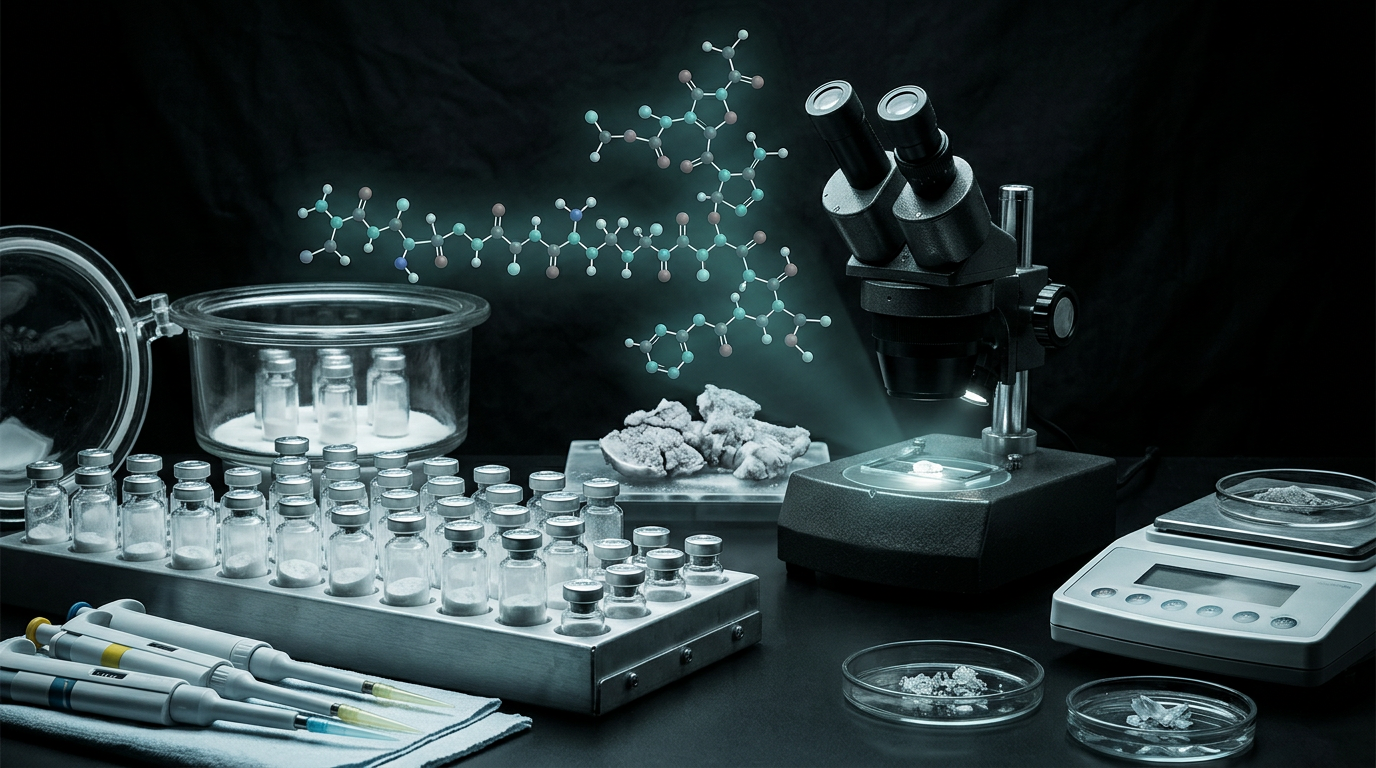
Introduction to Lyophilized Research Peptides
Lyophilization, or freeze-drying, is a dehydration process utilized to preserve the structural integrity and biological activity of fragile molecules such as synthetic peptides. Lyophilized research peptides are delivered in a stable, powdered format, which is achieved by freezing the material and then reducing the surrounding pressure to allow the frozen water in the material to sublimate directly from the solid phase to the gas phase.
This methodology is preferred in laboratory settings because it significantly extends the shelf life of the compound compared to liquid solutions. By removing moisture, the rates of hydrolysis and chemical degradation are drastically reduced, ensuring that researchers work with a standardized and high-purity material during their initial assays.
The Science of Sublimation and Stabilization
The production of lyophilized research peptides involves a precise three-stage thermal cycle: freezing, primary drying, and secondary drying. During primary drying, the majority of the solvent is removed via sublimation. Secondary drying further reduces residual moisture to levels typically below 3%, which is critical for preventing the degradation of peptide bonds and maintaining the conformational stability of the amino acid sequence.
To ensure a stable 'cake' structure within the vial, peptides are often formulated with cryoprotectants or bulking agents like mannitol or trehalose. These additives protect the peptide’s secondary structure from the physical stresses of freezing and ensure that the resulting powder remains porous, which facilitates rapid and complete reconstitution when the researcher is ready to begin testing.
Storage and Thermal Stability in Laboratory Environments
One of the primary advantages of utilizing lyophilized research peptides is their resilience to temperature fluctuations during transit. While liquid peptides may degrade within hours at room temperature, the lyophilized form remains stable for several days or even weeks in ambient conditions, provided they are kept away from direct light and excessive heat.
For long-term preservation, researchers should store these compounds at -20°C or -80°C. Maintaining a consistent cryogenic environment minimizes the risk of oxidation and deamidation. It is also standard laboratory practice to allow vials to reach room temperature before opening them; this prevents atmospheric moisture from condensing inside the vial, which could prematurely initiate degradation of the dry powder.
Reconstitution Protocols for Analytical Accuracy
To transition lyophilized research peptides from their stable solid state to an active liquid state, a sterile diluent—most commonly Bacteriostatic Water or Sterile Saline—must be introduced. The choice of solvent depends heavily on the peptide's hydrophobicity and the requirements of the specific experimental model. Some highly basic or acidic peptides may require a small amount of acetic acid or ammonium hydroxide to achieve complete solubility.
Precise reconstitution is vital for maintaining the correct molarity of the solution. Researchers are advised to gently swirl the vial rather than vigorously shaking it, as mechanical shear stress can denature complex peptide chains or cause foaming, making accurate pipetting difficult. Once reconstituted, the peptide’s stability period decreases significantly, necessitating immediate use or short-term refrigerated storage.
In-Vitro Application and Experimental Design
In a controlled laboratory setting, the use of lyophilized research peptides allows for high-throughput screening and consistent dosing across multiple replicates. Because the starting material is a standardized mass, researchers can calculate precise concentrations for cell culture studies or enzymatic assays, ensuring that variables remain controlled and findings are reproducible.
The purity profile, often verified by High-Performance Liquid Chromatography (HPLC) and Mass Spectrometry (MS), ensures that the observed biological effects are attributable to the peptide sequence itself and not to residual contaminants. This level of precision is fundamental for elucidating receptor-ligand interactions and signaling pathways.
Research Use Only Disclaimer
This article is provided for educational and laboratory research purposes only. Lyophilized research peptides are intended strictly for in-vitro experimentation and laboratory evaluation in a controlled research environment. They are not intended for human or veterinary use, nor are they designed for the diagnosis, treatment, or prevention of any medical condition.
Proper safety protocols, including the use of personal protective equipment and aseptic techniques, must be followed at all times when handling these substances. The information contained herein does not constitute medical advice or clinical recommendations.
More questions?
Ask our Support Team — they can answer follow-up questions about this topic, COAs, storage, or anything else in the research library.
Tap the "Chat with us" tab on the right edge of any page.