Understanding HPLC Tested Peptides
High-Performance Liquid Chromatography (HPLC) is the gold standard for assessing the chemical purity of synthetic peptides. HPLC tested peptides are those that have undergone rigorous chromatographic separation to identify and quantify the primary peptide sequence in relation to residual impurities, such as truncated sequences, deprotected fragments, or solvents. This analytical process is critical for researchers who require documented evidence of a sample's composition before proceeding with quantitative assays.
In a laboratory setting, the term 'purity' specifically refers to the percentage of the target peptide relative to other ultraviolet-absorbing components at a specific wavelength, typically 210–220 nm. By utilizing HPLC tested peptides, investigators can account for the exact molar concentration of the active peptide moiety, ensuring that experimental variables remain controlled and data sets remain reproducible across different study phases.
The Mechanics of Reverse-Phase HPLC
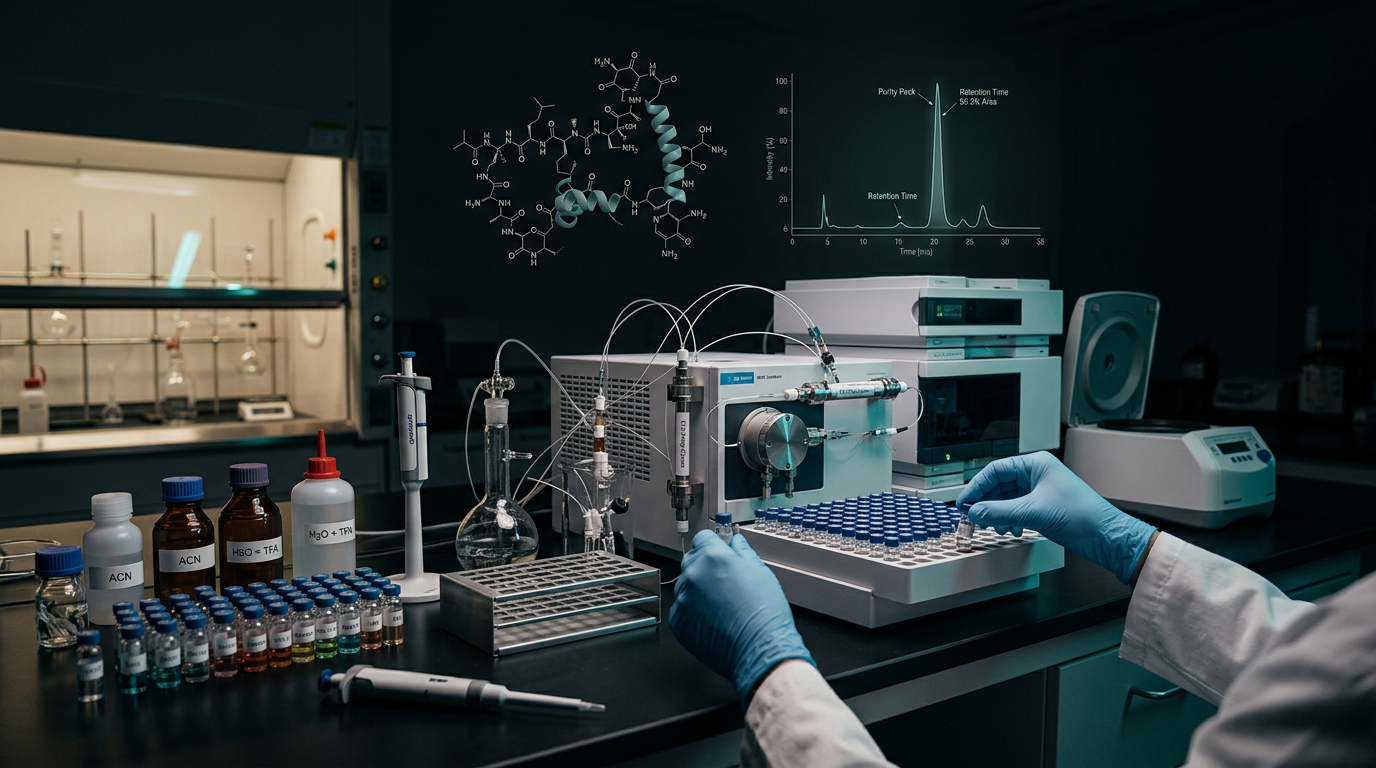
The most common methodology for verifying peptides is Reverse-Phase HPLC (RP-HPLC). This process utilizes a non-polar stationary phase (usually C18 or C8 silica columns) and a polar mobile phase consisting of water and an organic solvent like acetonitrile. Peptides are separated based on their hydrophobicity; as the concentration of the organic solvent increases through a gradient, the peptide is eluted from the column at a specific retention time unique to its physical properties.
The resulting chromatogram provides a visual and mathematical representation of the sample's purity. A single, sharp peak indicates a high degree of homogeneity, whereas multiple peaks signal the presence of related substances or degradation products. For high-precision research, HPLC tested peptides typically require a purity profile of 95% to 98% or higher to minimize the interference of synthesis byproducts in sensitive biological systems.
Integration with Mass Spectrometry
While HPLC determines the purity of a sample, it does not inherently confirm the identity of the molecular species. Therefore, HPLC tested peptides are frequently paired with Mass Spectrometry (MS) to verify the molecular weight. The combination of LC-MS allows researchers to confirm that the dominant peak identified during the HPLC phase corresponds exactly to the predicted mass of the synthesized peptide sequence.
This dual-verification ensures that the peptide is not only pure but also correctly sequenced. Without this combined analytical confirmation, researchers risk utilizing samples that may contain 'deletion sequences'—peptides missing one or more amino acids—which can elute closely to the target peak but exhibit significantly different biochemical properties.
Considerations for Quantitative Laboratory Research
When working with HPLC tested peptides, it is important to distinguish between peptide purity and peptide content. HPLC measures the ratio of the target peptide to other peptide impurities, but it does not account for non-peptide components such as counterions (e.g., TFA, acetate) and residual water. Understanding the distinction is vital for accurate gravimetric measurements in the laboratory.
Researchers should consult the Certificate of Analysis (CoA) provided with HPLC tested peptides to interpret the chromatogram's integration data. This data provides a baseline for calculating the effective concentration needed for in vitro studies or biochemical signaling assays, allowing for precise titration and dose-response modeling.
Laboratory Use and Research Disclaimer
The information presented in this article is for educational and laboratory research purposes only. HPLC tested peptides are intended solely for use in controlled laboratory environments by qualified professionals to investigate biochemical pathways and molecular interactions.
These substances are not for human or animal consumption, nor are they intended for diagnostic or therapeutic use. No medical claims are made regarding the applications of these peptides. Strict adherence to laboratory safety protocols and local regulatory guidelines is required when handling synthetic peptides for research.
More questions?
Ask our Support Team — they can answer follow-up questions about this topic, COAs, storage, or anything else in the research library.
Tap the "Chat with us" tab on the right edge of any page.