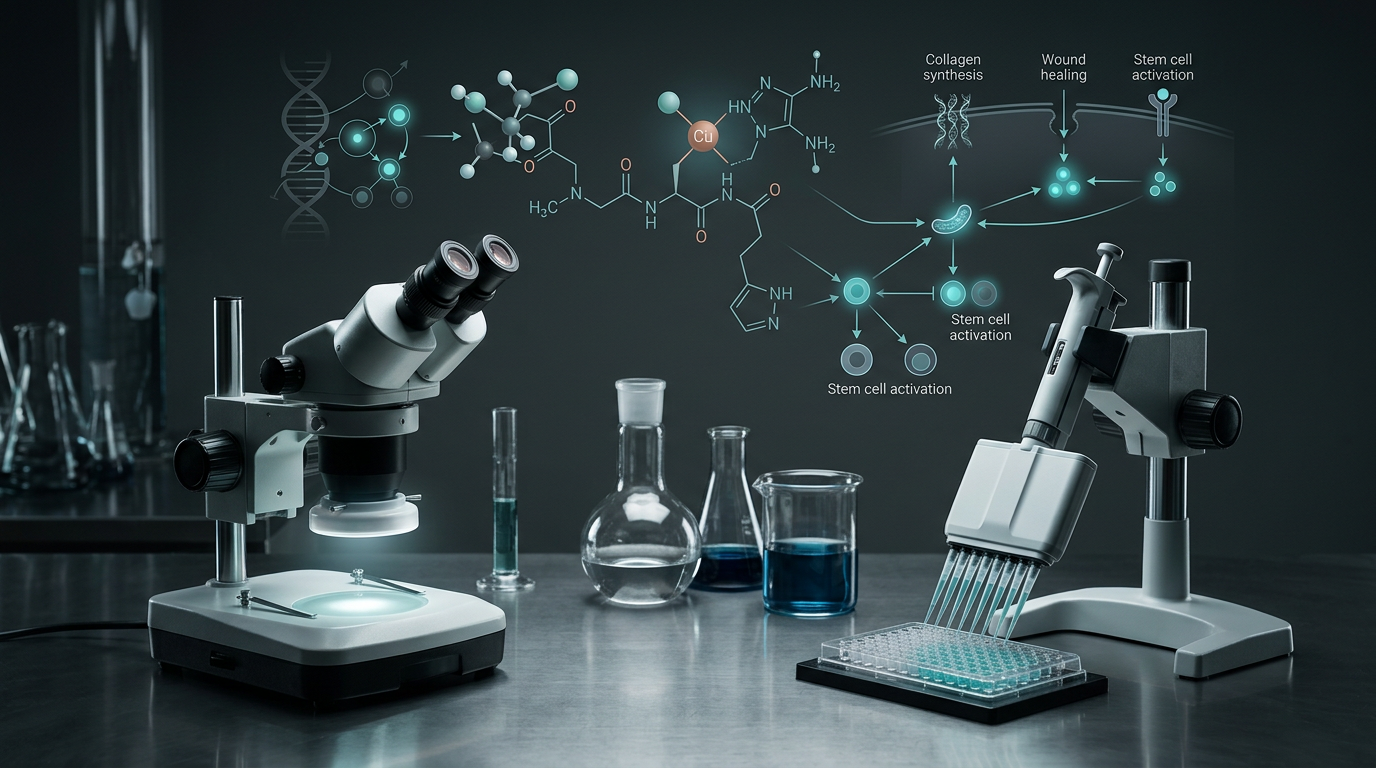
Biochemical Structure and Copper Affinity
GHK-Cu (Glycyl-L-histidyl-L-lysine copper) is a naturally occurring tripeptide-copper complex first isolated from human plasma. It exhibits a high affinity for copper (II) ions, forming a stable complex that facilitates the transport of copper to various cellular targets. This interaction is critical for the function of several copper-dependent enzymes, including superoxide dismutase (SOD) and lysyl oxidase, which are essential for oxidative stress management and extracellular matrix stabilization.
The molecular structure of GHK allows it to function as a modulator of copper homeostasis. Research indicates that the tripeptide can sequester copper from potentially toxic sites and redistribute it to intracellular compartments where it is required for metabolic processes. This binding capability is central to its role in influencing cellular signaling and gene expression across multiple tissue types.
Cellular Pathways and Gene Expression
A narrative review from a commercial skin-care research department reports that GHK stimulates both the synthesis and the breakdown of collagen and glycosaminoglycans, modulates metalloproteinases and their inhibitors, and is capable of up- and downregulating at least 4,000 human genes (PMID: 26236730). That gene-count figure and the review's description of the effect as resetting DNA to a healthier state are the authors' own framing of expression changes, not a demonstrated DNA-repair mechanism, and the affiliation is worth keeping in view when weighing the review.
Work outside dermatological models is more recent and model-specific. In an experimental silicosis mouse model, supported by RAW264.7 alveolar macrophage cell work, GHK-Cu bound peroxiredoxin 6 and attenuated lung inflammation and fibrosis, partly through inhibition of silica-induced oxidative stress in alveolar macrophages (PMID: 38879894). In C2C12 myotubes and a cigarette-smoke-exposed mouse model, GHK-Cu at 0.2 and 2 mg/kg reduced smoke-induced muscle mass loss and improved grip strength, with SIRT1 binding and activation as the proposed mechanism; the human component of that study was an observational plasma-GHK comparison in nine COPD patients against eleven controls, not a treatment study (PMID: 36905132).
Analytical Characterization and Quality Control
For laboratory research, the purity and identity of GHK-Cu must be verified using High-Performance Liquid Chromatography (HPLC) and Mass Spectrometry (MS). Given its status as a copper-peptide complex, specific attention must be paid to the molar ratio of copper to peptide. An incorrect stoichiometric balance can alter the complex's stability and biological activity in experimental models.
A Certificate of Analysis (COA) for GHK-Cu should provide data on residual solvents, heavy metals, and peptide purity. Research applications require a purity threshold typically exceeding 98%. Contaminants or uncomplexed copper ions can introduce confounding variables in cell culture or animal models, potentially masking the primary mechanism of action being studied.
Regulatory Status and Research Classification
GHK-Cu is classified strictly as a research chemical and is not approved by the U.S. Food and Drug Administration (FDA) for therapeutic or diagnostic use in humans. It is widely included in topical cosmetic formulations as an anti-wrinkle ingredient, and a 2024 review concludes that cellular studies support that categorisation while noting a surprising absence of clinical studies of GHK-Cu and Pal-GHK, and insufficient published information on their skin permeability and effectiveness (PMID: 39963574). Cosmetic prevalence is therefore not evidence of clinical efficacy, and systemic or parenteral use remains within the preclinical research domain.
Investigators must adhere to institutional biosafety guidelines when utilizing GHK-Cu in laboratory settings. Its classification as a research tool means it lacks established safety profiles for clinical applications. The compound's legal status is governed by its designation for in vitro and animal research only, and it is not intended for human consumption or administration.
Laboratory Research Use Only Disclaimer
The GHK-Cu mentioned herein is intended for laboratory research use only. It is not for human use, nor is it intended for clinical or diagnostic purposes. This article does not provide medical guidance or administration protocols. All findings presented are derived from published scientific literature and are intended to inform the design of future preclinical investigations.
Related
- research-safety-basicsarticle
References
- GHK Peptide as a Natural Modulator of Skin RegenerationPMID: 26236730
- GHK-Cu attenuates lung inflammation via peroxiredoxin 6PMID: 38879894
- GHK-Cu rescues skeletal muscle dysfunction via sirtuin 1PMID: 36905132
- Topically applied GHK as an anti-wrinkle peptidePMID: 39963574
More questions?
Ask our Support Team — they can answer follow-up questions about this topic, COAs, storage, or anything else in the research library.
Tap the "Chat with us" tab on the right edge of any page.